ROTONDE
Roundabout Specific Sculpture
A roundabout is one of the few places where anything placed on it can normally be viewed only from predetermined viewpoints. Another limitation is the short time slot allotted to experience the situation. These apparent constraints limit the possibilities we have; at the same time they can, and should, be used to our advantage. The void within a roundabout is usually filled with something natural or is often used to exhibit a sculpture. Art, however, is generally meant to be observed for a period of time and preferably processed or even assimilated — at least as far as the artist is concerned.
Art on a roundabout has specific possibilities which differ from those in other situations or settings. The observer does not choose to stop; the encounter is unavoidable yet brief. Art made specifically for the road environment should therefore not be too demanding, whereas in other situations it can be as complex as necessary or may even require, or at least invite, physical proximity or touch. By contrast, a work on a roundabout is approached from one direction and perceived while moving around it, the views continuously evolving as part of a predetermined pattern imposed by traffic movement.
This movement animates the sculpture. The work unfolds in time rather than through a single spatial experience alone. Depending on the country, this sequence may develop clockwise or counter-clockwise, a condition that becomes significant when direction or progression forms part of the artistic concept. The spatial quality of three-dimensional art alone is, in the case of a roundabout, not sufficient in itself. There is much more to utilize than regarding a roundabout merely as a place to locate art.
A roundabout should therefore not be understood simply as a pedestal in traffic space, but as a dynamic viewing system in which speed, sequence and memory become part of the work itself. The projects presented here include sculptures developed specifically for roundabout situations, as well as an earlier work later incorporated into such an environment, illustrating another common approach to the use of art in traffic space. Together they reflect an ongoing exploration of sculpture within the conditions imposed by movement, infrastructure and public space — conditions that suggest the possibility of roundabout specific sculpture, and more broadly roundabout specific art.
A roundabout in Kangasniemi
QUISNAM·VERTITUR

I — Genesis
The sculpture derives from a geometric transformation explained here through a simple image.

One may imagine a stainless-steel tube rolled into a circular ring with a diameter of 7 meters, standing vertically. At its highest point the ring is opened, and the two ends are drawn apart along the axis of the circle until their separation equals 10 meters, twice the eventual height of the sculpture. The gap is bridged by a straight tube of identical dimension, creating a continuous structure in which curvature and linear direction coexist.
This circular origin serves only as an explanation of the geometry. In reality the sculpture was fabricated from six prepared steel elements and assembled on site.
The straight connecting section follows the axis of the main through road — Highway 13 — embedding the work directly within the movement it addresses.

II — Transformation
The resulting form possesses no single stable appearance. Seen along its axis, the sculpture projects as an ellipse. Viewed perpendicular to it, the same structure appears as a triangle balanced on its point.
Between these positions the form continuously transforms.
While moving around the roundabout, perception shifts gradually from one geometric condition to another. The object itself remains unchanged, yet its apparent configuration evolves without interruption, producing the impression that the sculpture rotates or reorients independently of the observer.
The work reveals itself mainly through movement.

III — Experience
This effect became fully evident only after installation.
Driving around the completed roundabout, the changing form created an unexpected reversal: the sensation was not of circling a fixed object, but of the object turning within space itself, countering the direction in which the viewer is headed. The experience surprised even its maker.
At times motorists continued circling simply to experience the transformation again, responding instinctively to the shifting geometry.

IV — Resolution
From this observation the title emerged:
QUISNAM·VERTITUR

Who, in fact, is turning.
A roundabout in Heemskerk
HEEMSKERK
The Netherlands

I — Structure
The sculpture consists of two stainless-steel semicircular tubes.
Each segment is rolled to form half of a circle with a diameter of 9 meters. Together they describe the contour of a complete ring, though the circle is never closed.
The upper ends meet at a virtual hinge point defined by the axis of the tube. The lower ends remain separate and are spread outward along the axis of the original circle until their distance equals their diameter: 9 meters.
The two leaning semicircles and the distance between their base points form an isosceles triangle with sides of 9 meters and a height of approximately 7.8 meters.
The elements are not vertical; they incline away from and toward the observer when seen along their axis.
Material: stainless-steel tube with a longitudinally ground surface, producing a faceted reflection in changing light.

II — Appearance in Motion
The work, Rotonde, is installed at the intersection of the Baandert and the Jan van Kuikweg near the entrance to Heemskerk.
Perceived along the axis of the semicircles, the leaning halves project together as a horizontal ellipse.
Perceived from a position perpendicular to that axis, the same structure reads as an inverted V — an A-like figure standing with spread legs.

Between these two principal conditions, the form transforms continuously as one moves around it.
The structure itself does not change. Its projection does.

III — Orientation
A roundabout compels circumvention. The observer does not face the work from a single direction but moves around it.
Because two main traffic axes intersect here, two primary appearances are established. Each approach carries its own configuration. The gradual transition between them produces a controlled metamorphosis.
The sculpture reduces itself to essential contour in order to function under conditions of speed. Detail yields to clarity.
In the larger urban field, orientation emerges not from a fixed image, but from transformation.
The infrastructure adapted to the sculpture
ROTTERDAM
The Netherlands

I — Essence of a non-roundabout
The sculpture is not located on a roundabout.
Three square concrete planes, each twenty centimeters thick, are connected perpendicularly. Their configuration recalls a three-bladed propeller — angular, geometric, resting on three points.
The form originates from a cube of seven meters. Standing on one corner, three lower planes were removed. The remaining three were then shifted outward, each sliding halfway over the edge of the adjacent plane in an anticlockwise sequence. The closed volume opens; mass becomes orientation.
Although immobile, the structure suggests rotation. Its geometry implies a centrifugal movement that, if continued, would lift the form upward. The sculpture stands on an acute corner of the Marconiplein junction, projecting into the traffic flow. Vehicles pass continuously around it. What is fixed establishes a virtual circular motion.

II — Infrastructure
The work is installed at the intersection of Mathenesserlaan and Schiedamseweg, beside the Marconiplein metro station's entrances — a dense metropolitan node above and below ground.
Beneath the surface lies an intricate network of cables, water mains, drainage systems, data lines, even trees and an officially designated dike axis that must remain untouched. The entire area is raised ground, structured by invisible regulations and technical constraints.
Finding space for the sculpture required locating a precise triangular zone within this unseen maze and the visual one on top of that. The preferred position could only be realised after the axis of the Mathenesserlaan was slightly adjusted.
The infrastructure adapted to the sculpture.
The perpendicular planes are a tribute to Jacobus Oud and Theo van Doesburg, both associated with De Stijl and active in the nearby Spangen district. Geometry here is not decorative — it is contextual.
Marconiplein is equipped with tram lines, overhead wires, traffic signals, light masts and signage. Within this layered environment the sculpture maintains clarity through scale and placement. Each concrete slab weighs 28,000 kilograms.
The inclined surfaces contrast with the prevailing horizontals and verticals of the surroundings. Observed from the Europoint towers, the chosen white tone aligns with the chromatic field of the station halls and adjacent structures.
Although not situated on a roundabout, the interlocking planes establish a centrifugal reading. Pedestrians, cyclists, vehicles and infrastructural vectors describe a circular condition around it.

Even though not on a roundabout, the dynamism of the constellation of the three interconnected squares comprising the artwork suggests a circular movement of the pedestrians, cyclists, vehicles and the virtual movement of all the infrastructure inhabiting this metropolitan junction of civilization around it.

III — Orientation
In 1986 I was commissioned to realise an artwork at the Marconiplein metro station. Limited space around the main station hall required reconsideration of placement.
Positioned at the projecting corner of the junction, the sculpture acquires maximum exposure to movement from multiple directions. Orientation does not depend on a frontal view. The work unfolds through passage. Each approach produces a different alignment of planes.
The sculpture does not present an image; it establishes a spatial condition within traffic and infrastructure.
A vortex in the roundabout
BARENDRECHT
The Netherlands


I — Rotation materialized
Vortical was conceived for one of the newly projected roundabouts along the perimeter of Barendrecht, where conventional intersections were being replaced by circular traffic systems.
The project was initiated by Monshouwer Contractors, who invited the artist, Henny Monshouwer to develop a proposal. She asked me to collaborate. Together we developed the form of a twisted cone derived from a simple strip of paper — the kind children roll into darts to blow through a tube. Our version was not elongated like a projectile but low and broad, closer to a cone-shaped pyramid.

The strip is twisted countering the direction of traffic circulating around the roundabout. The rotation of vehicles is mirrored and fixed in the mass of the sculpture itself.

II — Construction
The work measures 450 × 450 × 215 cm and is constructed in ferrocement. The choice of material was both practical and contextual: durable, capable of carrying the large curved volume, and appropriate to the building tradition of the commissioning company.

The surface was left untreated. Weather, moisture, frost and time gradually define its skin. In winter, a thin layer of snow emphasizes the first twist at the base and traces the straight generative line, on the rear, running upward to the apex.
The sculpture occupies the center of the traffic circle as a compact, pointed knob — restrained in scale yet clearly anchoring the rotational space.
III — Commission
The municipality of Barendrecht invited local companies to propose artworks for several of the new roundabouts. Monshouwer Contractors commissioned the design and constructed the sculpture, subsequently donating it to the municipality.
Relocated into rotation
ASSEN
The Netherlands

I — An earlier form in a later context
Discoid Form I was created in 1970, long before roundabouts became a dominant feature of Dutch traffic planning. The bronze sculpture measures Ø 180 × 80 cm and belongs to a series of hand-formed, tactile works exploring rotation, compression and equilibrium.
In 1974 the Municipality of Assen purchased the sculpture during a traveling open-air exhibition organized by the Dutch Ministry of CRM (Cultuur, Recreatie & Maatschappelijk Werk). In the decades that followed, the work was relocated several times as the city redesigned its public spaces.
Only much later did I discover that it had found its present position on the Harry Muskee Roundabout at the Rolderstraat.

II — A name and a place
The roundabout was named after the Dutch blues musician Harry Muskee (1941–2011), born and raised in Assen. The municipality dedicated the newly constructed traffic circle to his memory following a request by the Stichting Blues in Grolloo. The naming generated considerable public attention.
The association with a musician’s memorial does not alter the sculpture’s autonomy. If anything, the circular motion of traffic around the bronze form resonates quietly with the cyclical structures of music itself.
Unlike works conceived specifically for roundabouts, Discoid Form I was not designed for distant viewing from moving vehicles. It belongs to a category of sculptures that invite proximity. They are meant to be approached on foot, circled slowly, observed in changing light, and even experienced tactilely. The surface bears the memory of manual formation; its proportions respond to the human body rather than to traffic speed.

III — Continuity
Seen now in the center of a traffic circle, the sculpture enters a condition of perpetual rotation it was not originally intended for. Yet the discoid form — compact, inward, centripetal — holds its ground within this expanded field of movement.
Title: Discoid Form I
Date: 1970
Material: Bronze
Dimensions: Ø 180 × 80 cm
Current location: Harry Muskee Roundabout,
Assen
Acquired by: Municipality of Assen (1974)

A proposal based on the moving viewer
EL PASO
United States

I — Icon and rotation
In 2010 I was invited, together with three other sculptors, to develop a proposal for a sculpture on the planned traffic circle at the intersection of Sun Bowl Drive and West University Avenue at the University of Texas at El Paso (UTEP).
The advisory committee emphasized that the sculpture would be experienced exclusively from moving vehicles. No pedestrian access to the inner circle was foreseen. The work therefore had to function optically under conditions of speed and predetermined viewpoints.
The committee also expressed the wish that the sculpture might become an icon for the university and the El Paso–Ciudad Juárez region.
An icon, like a sculpture on a roundabout, must be legible in an instant. Its totality must be grasped within seconds. Complexity that requires prolonged contemplation loses force in such a setting. This parallel between iconography and traffic-circle sculpture became the conceptual point of departure for my proposal.

II — Form and metamorphosis
The proposed sculpture consisted of three two-dimensional stainless steel elements: two identical semicircular contours and one straight connecting line. The curves were positioned on perpendicular planes; their upper ends connected by a straight tube forming the hypotenuse between them.
When approached along one axis, the sculpture would project as an ellipse — the optical result of the two semicircles seen in projection. From a perpendicular direction, the same structure would appear as a right triangle balanced on a point.
The object itself would not change. Yet its two-dimensional projections would seem unrelated, producing the impression of transformation while remaining geometrically constant.
The sculpture was to be oriented precisely along the axes of the approaching roads, so that the shift between ellipse and triangle would unfold naturally as vehicles entered and circumnavigated the circle.

III — Region and interpretation
Although my work originates in geometric clarity rather than symbolic narrative, the site invited interpretation. El Paso and Ciudad Juárez form one metropolitan area divided by a political boundary. The two curved movements of the sculpture could be understood as two cities flowing toward one another, uniting at the base.
The straight horizontal connection at the top simultaneously unites and separates — a line that may be read as border.

Such symbolism was not imposed but allowed to emerge. Geometry remains primary; interpretation remains secondary.
The sculpture was conceived in stainless steel pipe (Ø 219 mm), welded and ground to a satin finish. Its projected dimensions were approximately 10 × 7.0 × 5 meters. Minimal maintenance would have been required. At night, recessed ground lighting could have caused the linear form to appear as light itself.
Two years later, an identical configuration was proposed for a projected roundabout in Kangasniemi, Finland, when the municipality’s kunnanjohtaja invited me to create a sculpture there; although the national road authority declined to fund the project and the realization was delayed while alternative support was sought, the work was eventually constructed in 2018—two kunnanjohtajas later—after I decided to finance the sculpture itself while the town covered the transport from the Netherlands and the construction of the foundation.
The UTEP commission was ultimately awarded to another sculptor, who realized an enlarged illuminated miner’s pick — a direct emblem of the university’s identity.
A gateway beside the roundabout
RHOON / ALBRANDSWAARD — GAIA
The Netherlands
I — Threshold
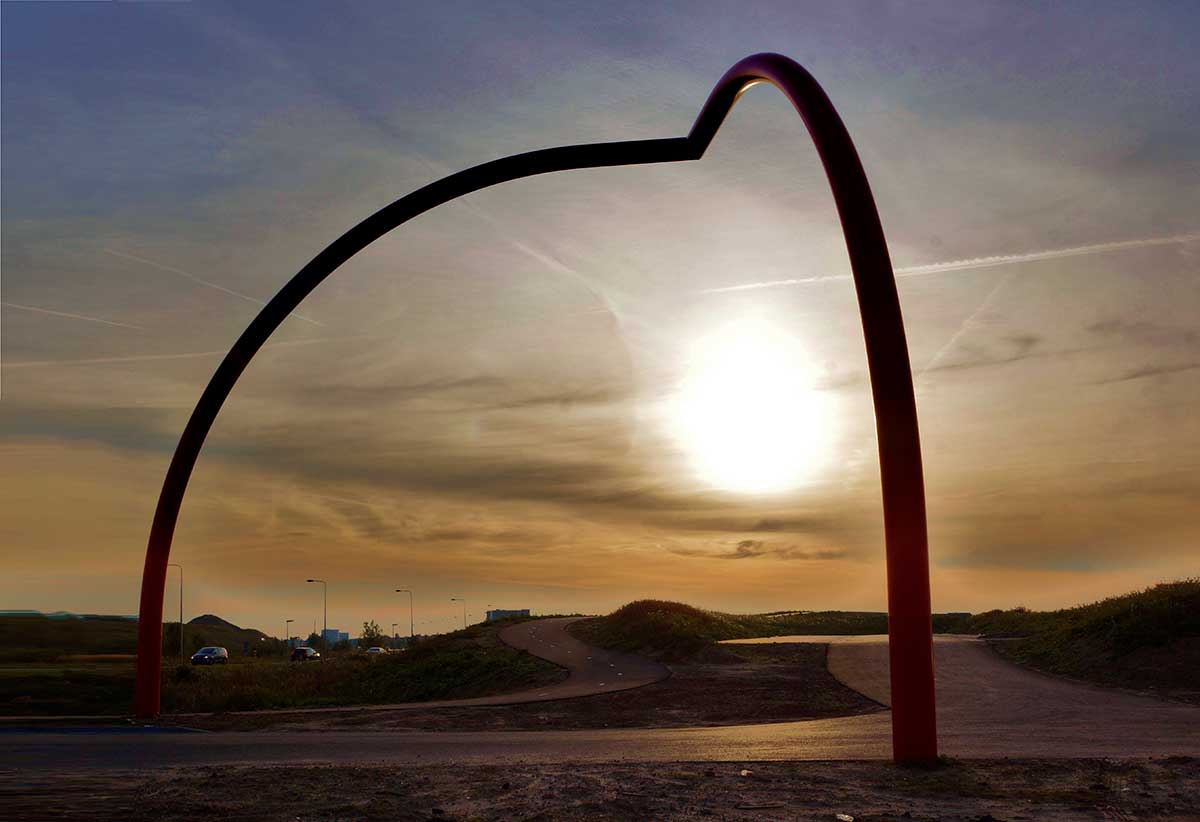
Unlike the other projects presented here, Gaia is not placed in the center of a roundabout, but directly beside it. Its function, however, remains inseparable from movement and approach: it is experienced as a threshold.
The sculpture stands at the entrance to the access road leading into the Buijtenland van Rhoon, a protected open landscape south of Rotterdam. Visitors arriving by car, bicycle or on foot pass beneath its span as they enter the area. The work therefore functions less as an object to be viewed than as a spatial condition to be crossed.
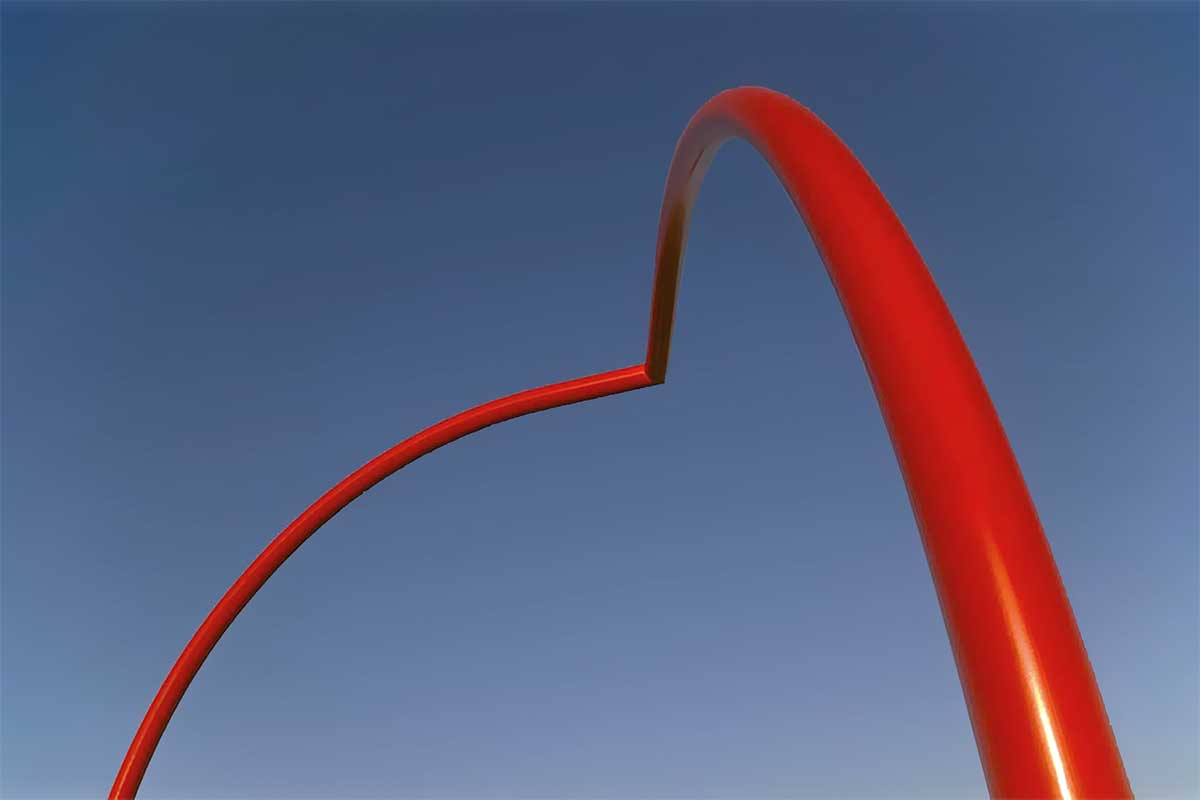
The form consists of two large steel quarter-arcs, meeting at an angular displacement rather than completing a half-circle. Together they establish a directional movement: not a closed rotation, but an opening — a guided passage. Their geometry directs the visitor forward, toward the landscape beyond.
II — Naming
The work was originally conceived for another urban situation, also as a passage structure through which traffic would move. Its later realization here proved unexpectedly appropriate. Positioned beside the roundabout rather than within it, the sculpture became more directly connected to the idea of entry itself.
For some time I referred to the work simply as Arch or Poort van Rhoon. The present title, Gaia, emerged later.
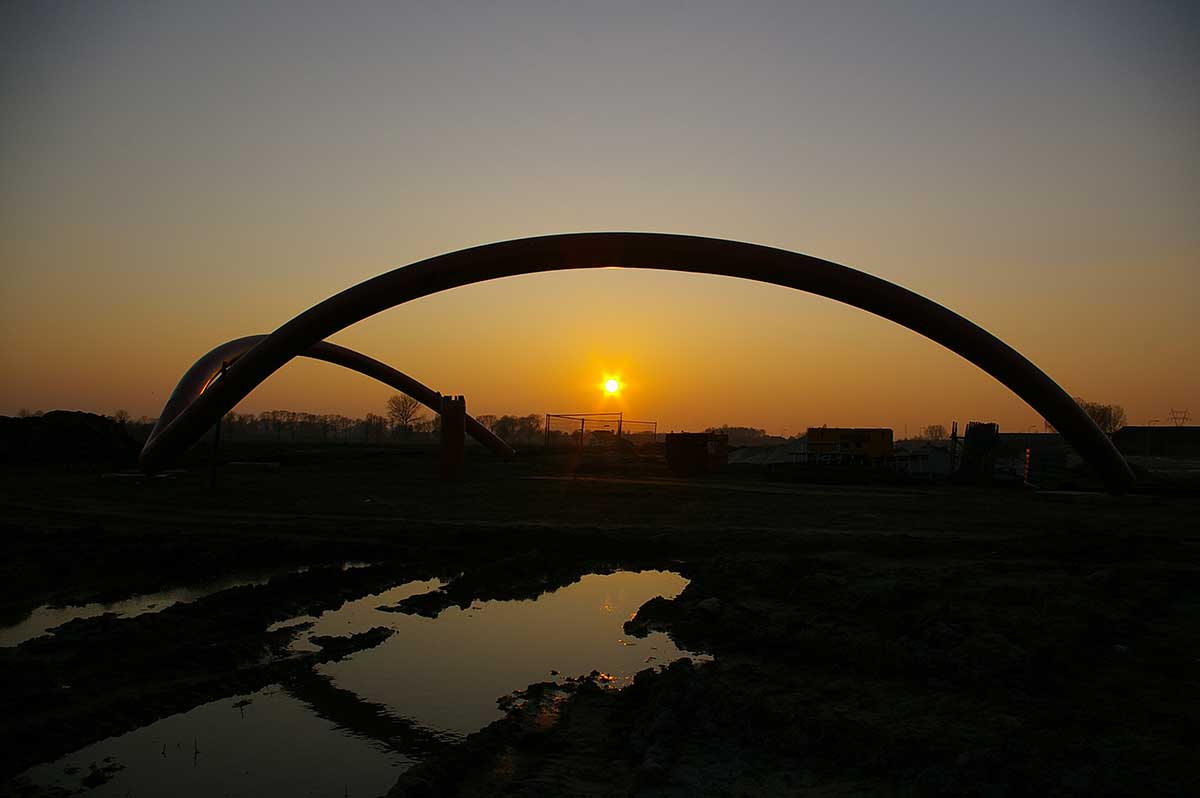
Before installation, while the sculpture lay horizontally in the landscape awaiting placement, I saw it differently: not as an upright gate, but as the reclining form of a woman in childbirth. That image remained with me. I decided that this horizontal position could one day exist as an independent work under the title Reclining Gaia. From that moment, the standing form required its own name: Gaia.
III — Arrival
The title also proved appropriate to the site. The work stands at the threshold of a landscape intended to remain open, cultivated and grounded in its relationship to the earth. As a gateway to that territory, Gaia became not only a formal structure, but a fitting name.
Although technical restrictions prevented placement within the roundabout itself, the sculpture now occupies a stronger position. It forms an actual gateway to the landscape beyond. The road passes under its span; the visitor enters through it.
The work does not mark a center of circulation, but the beginning of arrival.
Photography: Jo Polak ©
A roundabout as a second life
ZAANSTAD — PRINS BERNHARDPLEIN
The Netherlands
I — Removal and possibility
After the removal of my large steel sculpture, "Victory", from its long-standing location beneath the viaduct of the A8 in Koog aan de Zaan, several attempts were made to retain the work within Zaanstad. One of these possibilities was the large roundabout at Prins Bernhardplein, an important entrance to the city.
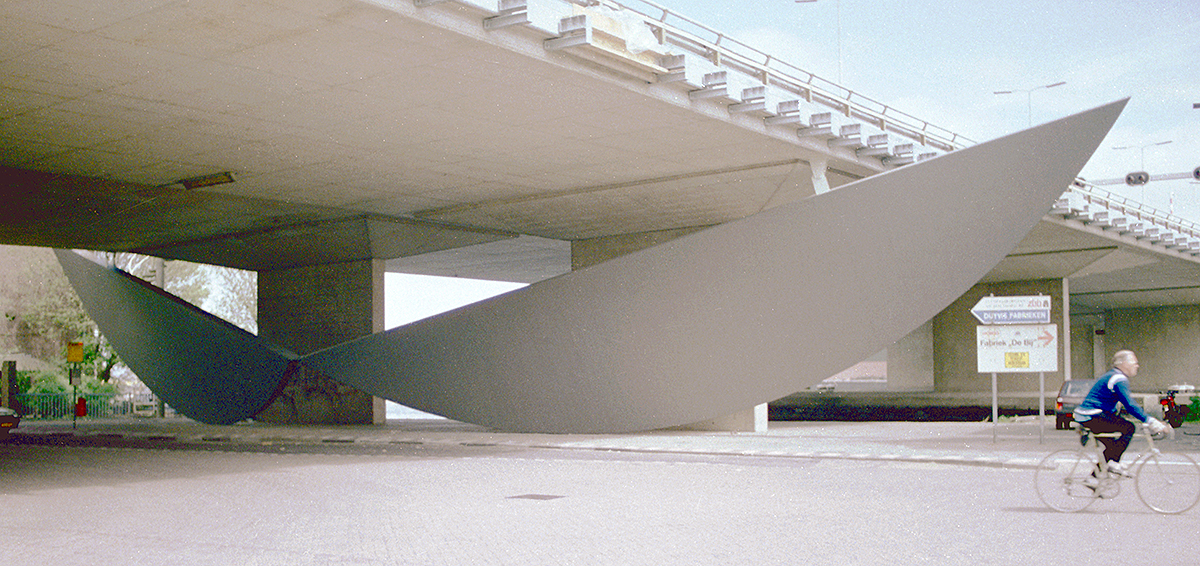
The original sculpture had stood for many years suspended beneath the viaduct, where its two joined large steel circular segments formed a powerful spatial intervention between street, bridge and water.
In that position, the two elements stood leaning like an immense V-shape, their wings enclosing the roadway. By drawing the lower joint forward toward the pedestrian side while keeping the upper contact points fixed against the viaduct, the structure inclined outward and simultaneously suggested the bow of a ship — an image appropriate to Zaanstad’s industrial and maritime identity.
After prolonged public controversy, the municipality decided to remove it. The work was dismantled and temporarily stored elsewhere along the Zaan, while possible new locations were investigated.
Many people in Zaanstad wished to keep the sculpture for the town, and I was asked to develop a proposal for the large Prins Bernhardplein roundabout at the city’s entrance.
II — Reconfiguration
The geometry of the original artwork began with a circle containing an inscribed square. This produces four equal circular segments whose chords correspond to the four sides of the square: each chord measuring 22 meters, with a rise of 3 meters from midpoint to arc. Constructed in steel plates, each segment had a structural thickness of 20 centimeters.
The two connected segments were a given as generative elements. By changing their orientation, inclination and relationship to the surrounding infrastructure, entirely new spatial readings became possible.
The four sketches presented here document these alternative possibilities: not as reconstructions of the former work, but as attempts to give the sculpture a second life through transformation rather than repetition.
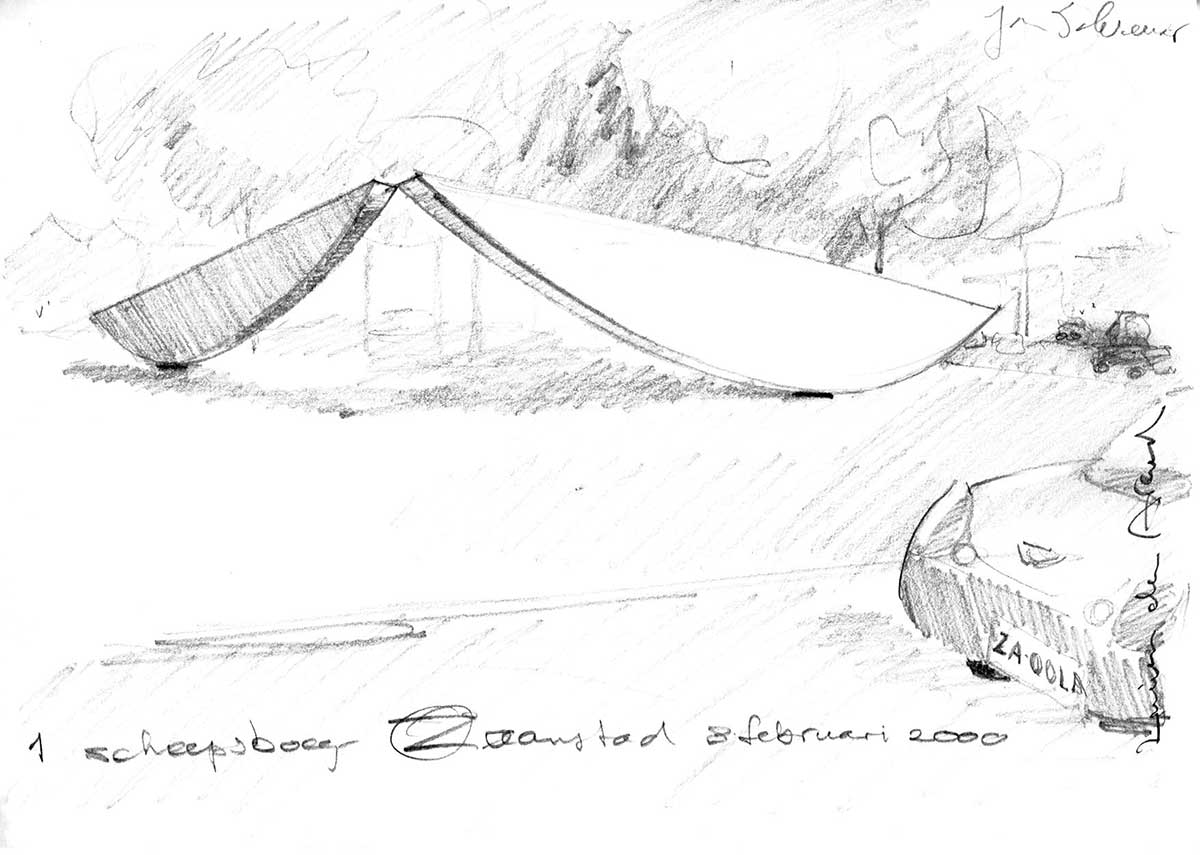
1 — Ship’s Bow
One of the alternative proposals
for the Prins Bernhardplein roundabout. The two circular segments create
a forward-leaning composition suggesting the bow of a ship, marking
the entrance to Zaanstad.
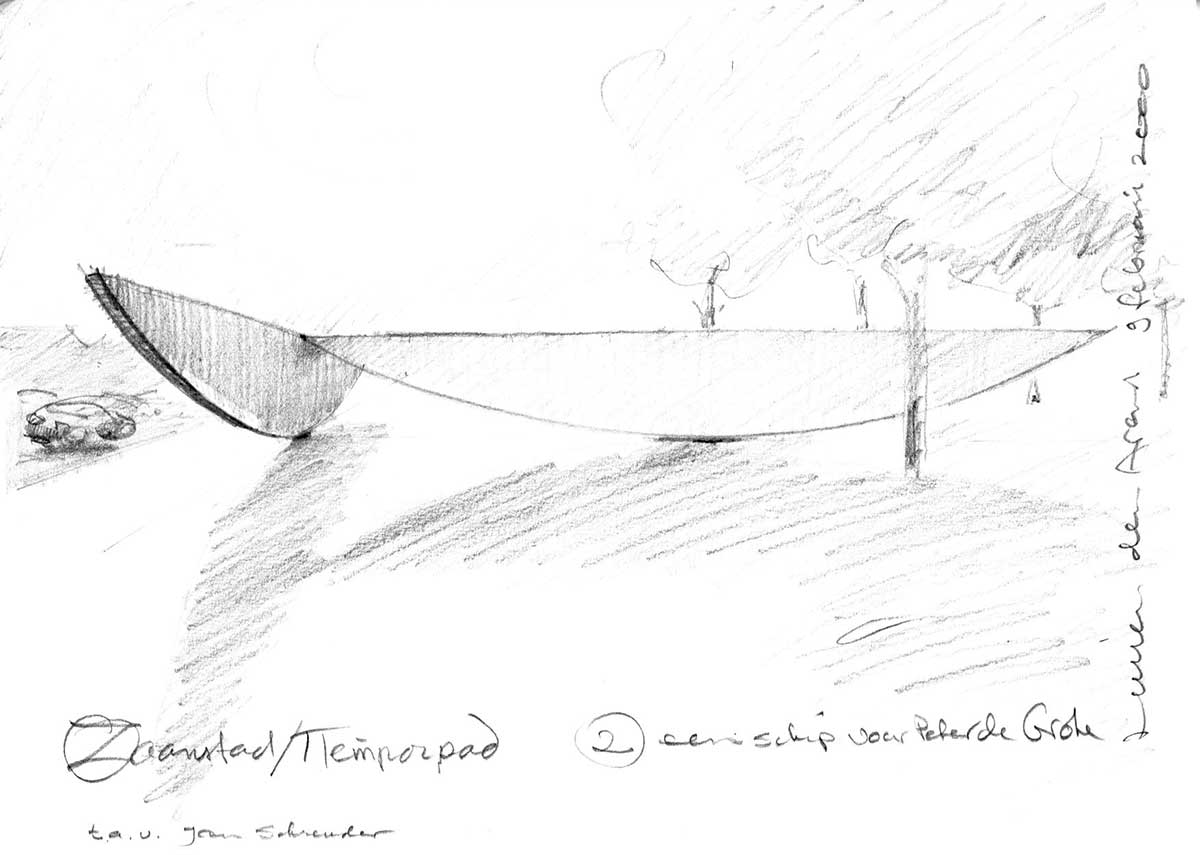
2 — A Ship for Peter the Great
Here the chords
are placed perfectly horizontal, resulting in a T-construction measuring
22 × 22 × 3 meters. Trees do not function as obstacles but become part
of a new environment.
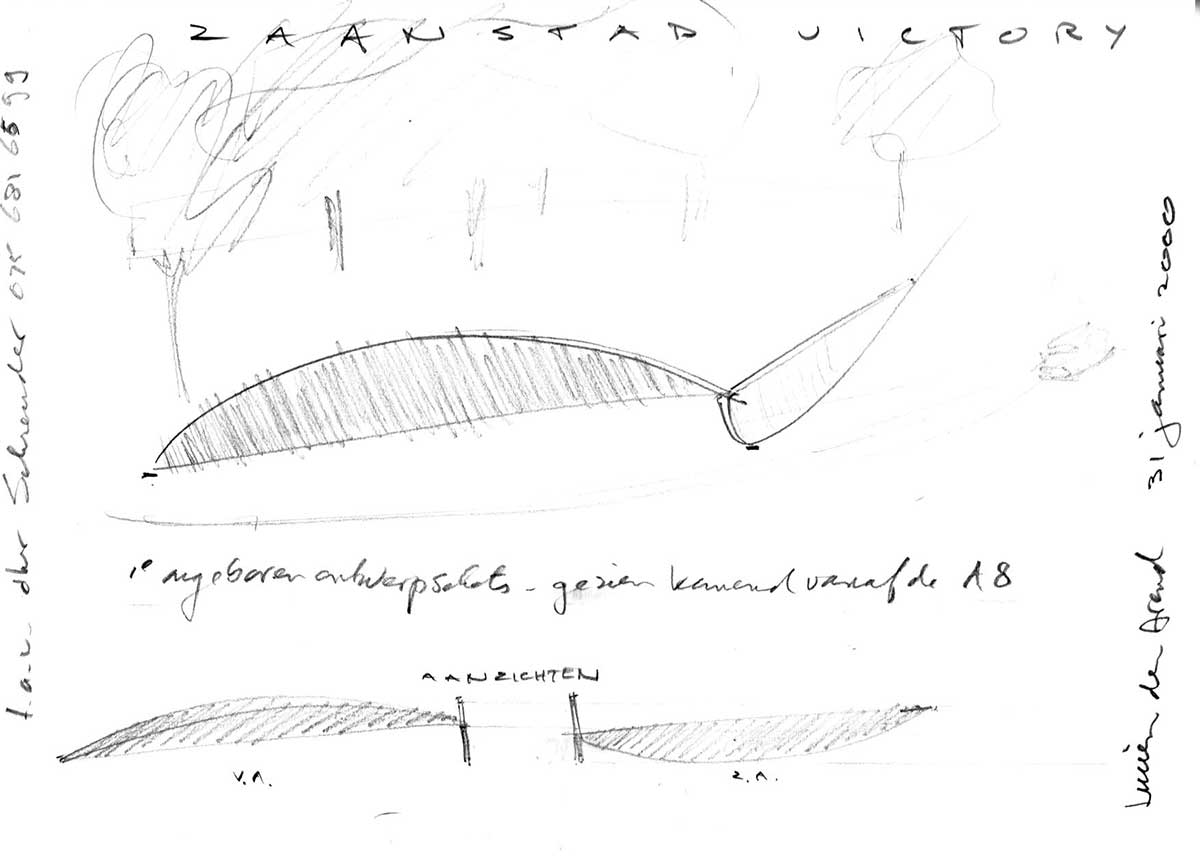
3 — First Unborn Sketch
Here the chords lie in
one plane. A point of one segment rests on the point of the other, creating
a balanced geometric tension.
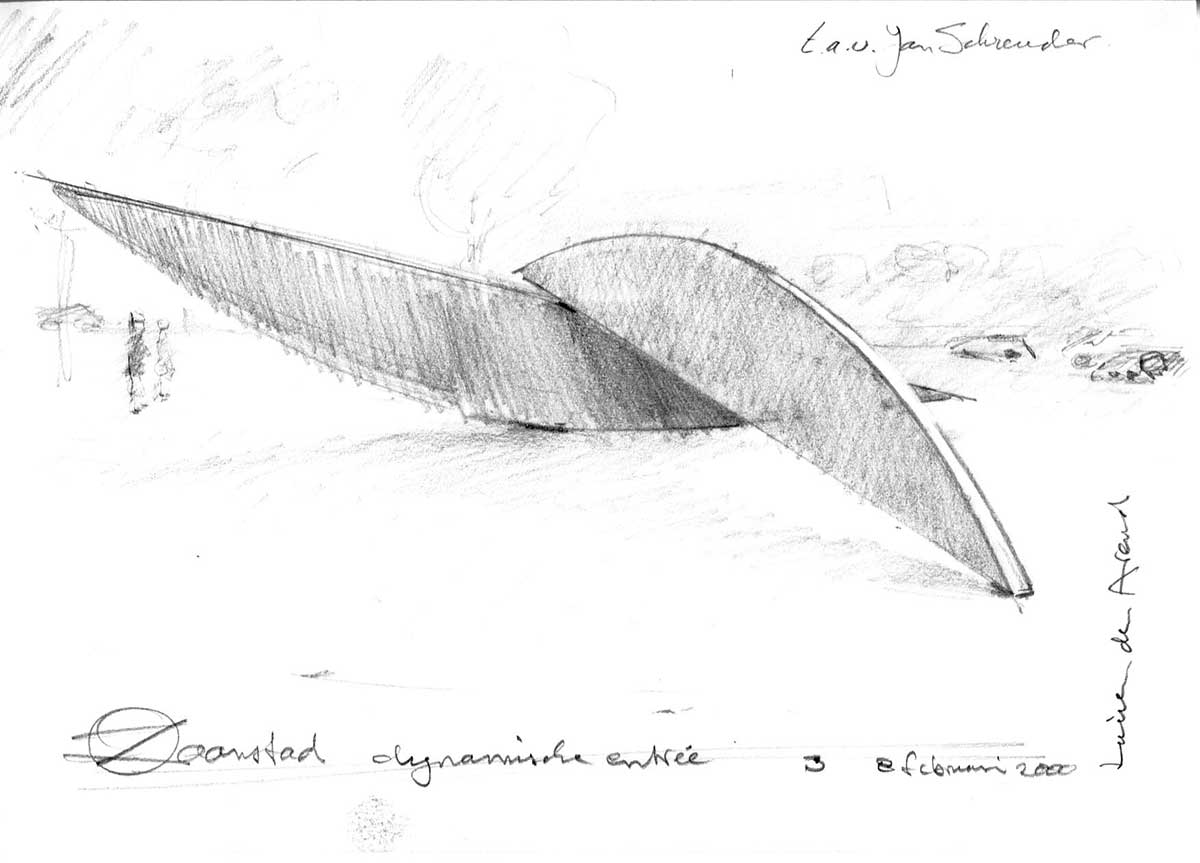
4 — Dynamic Entrance
Here the chords again lie
in one plane. One segment rests on the other as in the previous sketch,
but midway, creating a more dynamic and less symmetrical composition
responding to the given site.
III — Disappearance
In all variations, the final color was to be chosen to strengthen the sculpture in relation to its new environment.
None of these proposals were realized. After years of unsuccessful efforts to find a permanent new location, the remaining steel elements were eventually dismantled and scrapped.
What remained were the drawings — and the conviction that sculpture can continue to exist, even after its material disappearance, through the persistence of form and possibility.
Studies in the phenomenology of movement
a project by Lucien den Arend
2026 · roundabout specific sculpture / roundabout specific art